


If you've searched for the best peptide for weight loss, muscle recovery, or anti-aging, you've probably noticed something: everyone seems to have a favorite. Social media makes it easy to discover new treatments, but much harder to tell which ones are backed by good evidence, which are still experimental, and whether any of them make sense for you.
Building Beema Health has changed how I think about that question. I'm optimistic about peptide-based medicine, and I believe peptides and related medications can be valuable tools. They aren't miracle solutions, and choosing a treatment shouldn't begin with a product name. It should begin with a conversation about your goals, your health, and what you've already tried.
So, which peptide is right for you? It depends on your goal, on how strong the human evidence is for that goal, and on your own health history. There isn't one best peptide for everyone, and for many people the right first move is a conversation with a licensed clinician rather than a purchase.
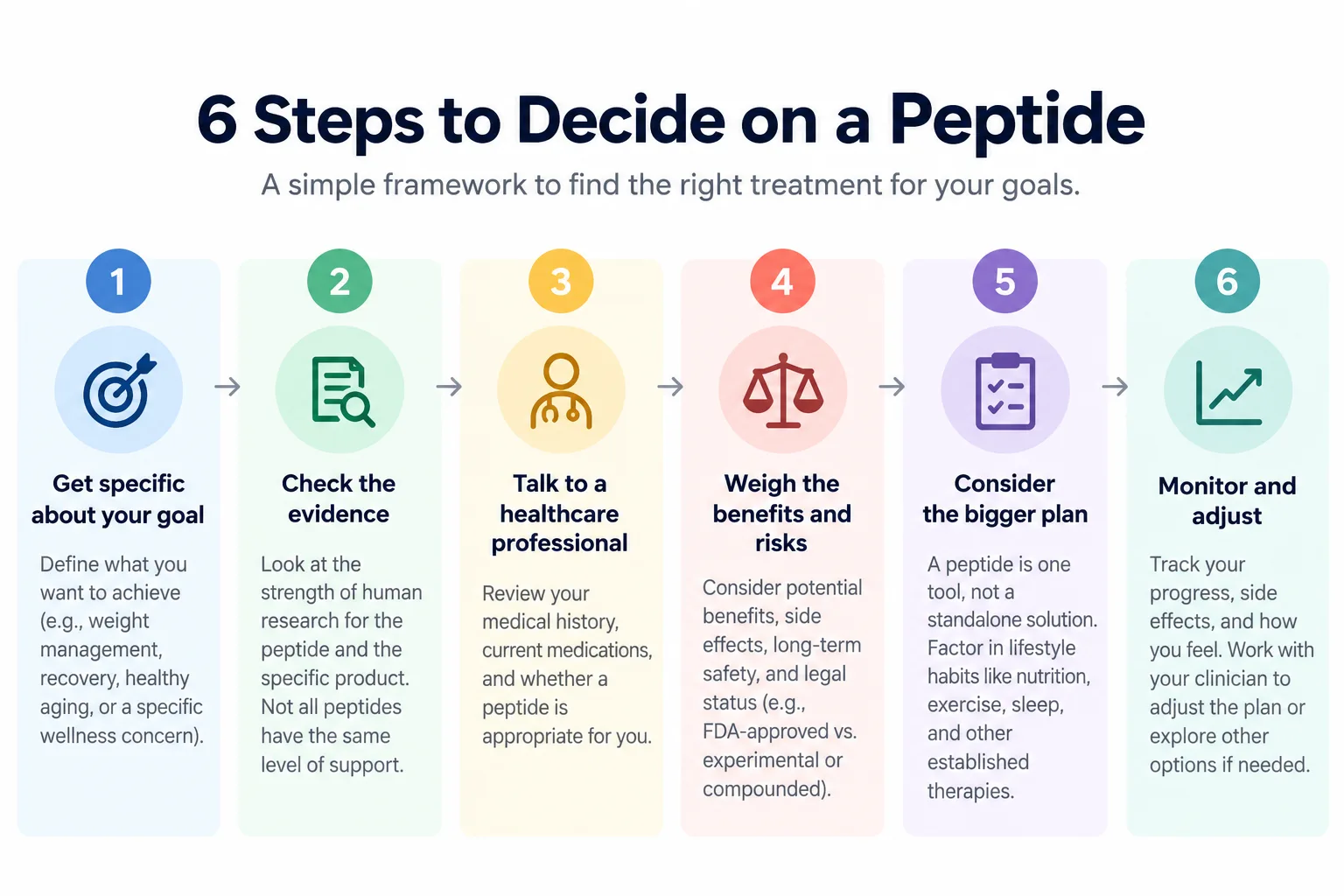
Here's the six-step approach I'd suggest to someone starting from scratch.
First, what exactly is a peptide?
Peptides are short chains of amino acids, the building blocks of proteins. Some act as signaling molecules in the body, and a number of peptide-based compounds have been developed into prescription medications.
That's the good news about the field. Teriparatide, for example, is an FDA-approved peptide medicine used to treat osteoporosis in certain patients, and octreotide is approved to treat acromegaly in patients who meet specific criteria. You can read the exact approved uses in the teriparatide label (opens in a new tab) and the octreotide label (opens in a new tab). Peptide medicine is much bigger than weight loss.
But peptide is a broad scientific description, not a stamp of medical approval. Two products described as peptides can have entirely different purposes, evidence, risks, and legal status. Approval is also specific: to a product, a condition, and a group of patients. And not everything sold alongside peptides is one. NAD+, for example, is a coenzyme, and familiar medicines like sildenafil or finasteride are small molecules.
So the first question isn't "Which peptide is strongest?" It's "What am I actually trying to address?"
Step 1: Get specific about your goal
If someone asks me how to choose the right peptide, my first question is usually: What are you hoping will change? Then I'd want to know what you've already tried, whether you've used related medications before, what questions you have, and what budget you can realistically sustain.
"I want to feel better" is a reasonable starting point, but it's too broad for a medical decision. Most people land in one of these groups:
- Weight and metabolic health: Are you looking for help managing obesity or a weight-related health condition?
- Muscle recovery and injury: Are you recovering from an injury, struggling between workouts, or dealing with a symptom that hasn't been evaluated?
- Growth hormone signaling and body composition: Are you curious about sermorelin or similar compounds because of something you read, or because of a diagnosed hormone issue?
- Skin and appearance: Are you interested in skincare ingredients, or in an injectable treatment?
- Healthy aging: Is there a specific condition you want to address, or a general hope to slow aging?
These goals shouldn't all lead to the same treatment. Some shouldn't lead to a peptide at all. A clinician may recommend an evaluation, rehabilitation, nutrition changes, another established therapy, or no medication. That isn't a disappointing answer. I'd rather someone make the right decision for themselves, even if that decision is not to buy anything from us.
Step 2: Check the evidence for your specific goal
One of the biggest misconceptions I've run into is that all peptides have roughly the same level of scientific support. They don't. For each goal, I'd ask three things: Has it been studied in humans? Was it studied in people like me? And was the study of this exact product, not a related one?
Weight management: the best-studied peptide-based medicines
The most developed evidence in this field is for two medications. Semaglutide is a GLP-1 receptor agonist, and tirzepatide acts on both GIP and GLP-1 receptors. FDA-approved products containing these medicines are approved for chronic weight management, alongside a reduced-calorie diet and increased physical activity, in eligible adults. The FDA's announcement of tirzepatide's approval (opens in a new tab) describes that use, and semaglutide has an additional approval to reduce the risk of serious cardiovascular events (opens in a new tab) in certain adults with obesity or overweight and established heart disease.
In randomized trials, eligible participants taking these medicines with lifestyle support lost more weight on average than comparison groups. That's genuinely promising, and it's worth being precise about what those studies tested: specific medicines, formulations, doses, and populations. Results from an FDA-approved product cannot automatically be applied to a compounded preparation. The FDA advises that compounded versions of GLP-1 drugs (opens in a new tab) should be used only when a patient's medical needs cannot be met by an approved drug.
Muscle recovery and injury: BPC-157 and TB-500
BPC-157 and TB-500 get a lot of attention in athletic and recovery communities. BPC-157 is a synthetic peptide, and TB-500 is a synthetic fragment related to thymosin beta-4. The interest makes sense on paper: researchers have proposed that these compounds may influence tissue repair. But a proposed mechanism, or a result in animals, is not the same as a demonstrated benefit in people.
For BPC-157, a 2026 systematic review of human research (opens in a new tab) found only three small studies involving 30 people in total, judged to be of poor methodological quality, and rated the overall certainty of evidence as very low. Neither substance is an FDA-approved drug. The FDA's compounding pages describe limited safety information and immunogenicity and impurity concerns (opens in a new tab) for both, and their regulatory status for compounding has been changing, so it's worth asking any provider exactly what they mean when they talk about availability.
This is a scientifically interesting area, and I wouldn't dismiss it. I also wouldn't choose a recovery treatment because an athlete or creator said it helped. A proper diagnosis and an evidence-based rehabilitation plan should come first.
Growth hormone signaling: sermorelin
Sermorelin is a synthetic fragment of growth hormone-releasing hormone (GHRH), the signal that tells the pituitary gland to release growth hormone. People look into it for body composition, recovery, sleep, or healthy aging.
Its regulatory history is worth understanding. Sermorelin was once FDA-approved as Geref, for diagnostic use and for treating growth failure in children with growth hormone deficiency. The manufacturer discontinued the branded products in 2008, and the FDA later determined the products were not withdrawn for reasons of safety or effectiveness (opens in a new tab). Today there is no marketed FDA-approved sermorelin product, so it is available only as a compounded medication. Compounded preparations are not FDA-approved.
The approved uses were pediatric and diagnostic. Using it for adult body composition, recovery, or anti-aging is not an FDA-approved use, and the evidence for those goals is limited. A different GHRH analog, tesamorelin, shows how specific approval is: it is approved to reduce excess abdominal fat in adults with HIV and lipodystrophy (opens in a new tab), and its label says it isn't for weight loss.
Because Beema Health offers compounded sermorelin evaluation, I want to be extra clear about this: a product being commercially available doesn't mean it has been proven safe or effective for your goal. Whether it's appropriate for you is a decision for an independent licensed provider, and a prescription is never guaranteed.
Skin and appearance: GHK-Cu
GHK-Cu is a naturally occurring copper-binding tripeptide, and it shows up in plenty of skincare products. It's a good example of how a peptide can be interesting without being an established treatment. Early research on topical use is preliminary, and a cream sold as a cosmetic is regulated very differently from a drug. A cosmetic claim about appearance also doesn't tell you anything about what happens when a substance is injected.
For injectable GHK-Cu, the FDA has said there are limited human data to inform safety (opens in a new tab). If your goal is skin health, a dermatology visit and a good evidence-based routine are the stronger starting points.
Healthy aging and longevity
I find this field exciting. Researchers are studying how peptide signaling pathways influence metabolism, tissue repair, and the biology of aging, and some of that work may matter a great deal in the future. But "anti-aging" is not one measurable medical outcome, and no single peptide has been proven to deliver every benefit people associate with that phrase.
If a product promises better energy, faster recovery, younger-looking skin, and a longer life all at once, ask which specific outcomes were demonstrated in well-designed human trials, for whom, and over what period. A goal you can measure, like a lab value or a specific symptom, is much easier to evaluate than a promise to reverse aging.
Step 3: Talk to a healthcare professional
Before considering any treatment, I'd want someone to complete an honest medical intake and discuss it with a licensed healthcare provider. That includes current conditions, medications and supplements, prior treatment experiences, and relevant personal or family history. Independent licensed providers, not a company or a website, decide whether a treatment is medically appropriate.
This is also where I'd put AI in perspective. I encourage people to research their options, and AI can help you understand medical terminology, summarize published research, and prepare better questions for your appointment. But it can get facts wrong or miss context, and it can't determine whether a prescription is appropriate. Be thoughtful about sharing sensitive health information with any online tool.
If you have general questions about how Beema Health works, I'm glad to talk them through. I can explain our process, but I don't provide clinical assessments or make prescribing decisions.
Step 4: Weigh the benefits, risks, and legal status
This distinction gets lost in peptide marketing, and it matters. Almost every product you'll come across falls into one of four groups:
- FDA-approved medications: The FDA has reviewed evidence supporting a product's safety and effectiveness for its approved use, as well as its quality and manufacturing. The medication still has risks and isn't suitable for every person.
- Compounded medications: These are prepared by a pharmacy for an individual patient's medical need when appropriate under applicable law. Compounded drugs are not FDA-approved, and the FDA does not review each preparation for safety, effectiveness, or quality before it is marketed. They are not automatically equivalent to approved products.
- Investigational or research peptides: A substance sold as "research use only" is not thereby established as safe or effective for human treatment.
- Cosmetic ingredients: These are regulated differently from drugs, and results from a cosmetic product don't support claims about injectable treatments.
The FDA's guidance on compounded drugs (opens in a new tab) explains these distinctions. It's reasonable to be curious about medical innovation. It's equally reasonable to ask: Is this an approved treatment for my condition, an individualized compounded prescription, an experimental product, or a cosmetic?
Every medication also has risks. FDA-approved GLP-1-based weight-management medicines, for instance, can cause gastrointestinal side effects such as nausea, vomiting, diarrhea, and constipation, and their labeling contains warnings and contraindications, including certain personal or family histories of medullary thyroid cancer or MEN2. The FDA-approved semaglutide prescribing information (opens in a new tab) lists them in full, and our plain-language guide to GLP-1 side effects covers what people commonly experience.
A few questions I'd bring to any provider:
- What evidence supports this particular medication for my goal?
- What are its most important side effects, contraindications, and unknowns?
- Is it FDA-approved for this use? If compounded, why would a compounded preparation be clinically necessary and legally available for me?
- Who evaluates my eligibility, writes the prescription if appropriate, and handles follow-up?
- Which licensed pharmacy would dispense it, and how can I verify that pharmacy?
- What will treatment and follow-up cost over several months?
Be cautious around guaranteed results, pressure to buy immediately, vague sourcing, or claims that a compounded product is "the same as" an FDA-approved drug. The FDA specifically cautions (opens in a new tab) against misleading promotion of compounded medications by telehealth companies.
Step 5: Consider the bigger plan
A peptide is one tool, not a standalone solution. Nutrition, physical activity, sleep, and consistency still do a lot of the work, and a medication works best when it supports those habits instead of replacing them. For weight management, NIH guidance (opens in a new tab) emphasizes the same point.
Charlie Beebout, who also works at Beema Health, has lost more than 70 pounds over about a year using a compounded GLP-1-based medication as part of a plan that also included healthier eating and regular weight training. What stands out to me isn't the number on the scale; it's the work that happened alongside the medication.
See Charlie's progress over time
Charlie's weekly weigh-ins, Sep 5, 2025 to Sep 18, 2026.
This is one person's result and is not typical. Individual results vary, and this chart is not a prediction of what you will experience.
Please read that as one person's story, not a promise. A loss like Charlie's is not typical. In the STEP 1 trial (opens in a new tab), adults taking FDA-approved semaglutide with lifestyle support lost 14.9% of their body weight on average over 68 weeks, compared with 2.4% on placebo, and many people lost less. Results depend on your health, your medication, your habits, and more. His experience isn't evidence that a compounded drug works or is safe for anyone else, and compounded drugs are not FDA-approved. Charlie and I both work at Beema Health, which offers telehealth services including GLP-1 care, so we have a stake in this topic and you should weigh the story with that in mind.
Planning for the long term matters too, including what you can realistically sustain financially. A follow-up to a semaglutide trial (opens in a new tab) found substantial weight regain, on average, after participants stopped treatment. That doesn't mean everyone will have the same experience, but it means the maintenance plan deserves attention from the beginning, and our guide to rebound weight gain after stopping GLP-1 goes deeper on it.
Step 6: Monitor and adjust
Choosing a treatment isn't a one-time decision. Before you start, decide what success would look like and how you'll measure it, whether that's a lab value, a symptom, or a specific function you want back. Then track how you feel, including side effects, and keep your provider in the loop.
A good plan includes a way to evaluate progress and decide whether to continue, change, or stop. Sometimes the best outcome of that review is a different approach, and that's the process working.
How we think about peptide-related care at Beema Health
When someone approaches me with questions, I want to understand their goal first. Then I'd ask what they've tried, what they're concerned about, and whether the cost works for them. If the most useful answer is "this treatment may not be the right fit," I think that matters just as much as finding one that is.
That's the philosophy we're trying to build at Beema Health: more informed decisions, realistic expectations, and real human support. We don't offer every treatment discussed in this article. Beema Health supports access to telehealth services, but independent licensed healthcare providers evaluate medical intake information and decide whether any treatment is appropriate or may be prescribed. A prescription is never guaranteed. When a prescription is appropriate, dispensing is handled by the relevant pharmacy.
If you're exploring medically supervised weight management, you can learn about the GLP-1 care process. If you're curious about growth hormone signaling, you can read about compounded sermorelin. To see how care works from intake to provider review to pharmacy fulfillment, read how it works, and our safety information covers side effects and contraindications. Reading about your options is a good first step, and you don't have to commit to a medication just because you're curious. If you have general questions, you can reach out to us.
Frequently asked questions
Which peptide is right for me?
It depends on your actual health goal, the quality of the evidence behind each option, your medical history, and your provider's assessment, not whichever treatment is trending. For some goals the answer may be an FDA-approved medication, for others a different kind of care, and sometimes no peptide at all.
What is the best peptide for weight loss?
There isn't one best choice for everyone. FDA-approved medications containing semaglutide or tirzepatide have evidence supporting specific weight-management uses, but eligibility, contraindications, tolerability, cost, and your clinician's judgment matter. Compounded versions are not FDA-approved and should not be assumed equivalent.
Are peptides safe?
It depends on the product. FDA-approved peptide medicines have been reviewed for their approved uses, and they still carry risks. Investigational or research peptides haven't been shown to be safe or effective for human treatment, and the FDA has described limited safety information for several of them. Ask a licensed provider about the specific product.
Are peptides for muscle recovery or anti-aging proven to work?
Some claims are being studied, but many products marketed for these goals lack strong human evidence for the advertised benefit. Look for meaningful clinical outcomes in well-designed human trials, not just animal studies, testimonials, or mechanistic theories.
What is sermorelin, and is it FDA-approved?
Sermorelin is a synthetic fragment of growth hormone-releasing hormone. It was once FDA-approved as Geref for pediatric and diagnostic uses, but there is no marketed FDA-approved sermorelin product today. It is available as a compounded medication, which is not FDA-approved, and using it for adult body composition or anti-aging is not an approved use.
Can a peptide in a skin cream do what an injection does?
Not necessarily. Topical cosmetic ingredients such as GHK-Cu and injectable treatments are different products with different regulation, and results from one don't support claims about the other.
What should I know before taking peptides?
Know whether the product is FDA-approved, compounded, investigational, or cosmetic. Know what evidence supports it for your goal, what its risks are, and who is prescribing and dispensing it. Share your full medical history with a licensed provider, and be cautious around guaranteed results.
How do I know whether a peptide source is legitimate?
For a prescription medicine, work through a licensed healthcare professional and a state-licensed pharmacy. Ask whether the exact product is FDA-approved or compounded, who makes and dispenses it, and why it is appropriate for you. The FDA's advice on unapproved GLP-1 products (opens in a new tab) is a useful starting point.
The bottom line
I'm excited about the future of peptide-based medicine. But the smartest way to choose a treatment is still pretty straightforward: start with your goal, check the quality of the evidence, understand whether a product is approved, compounded, investigational, or cosmetic, be open about your medical history, and make the decision with a licensed healthcare provider.
The right tool, if there is one, should support the life you're trying to build, not promise to do all the work for you.
Medical disclaimer: This article is general educational information, not personal medical advice. It does not diagnose conditions, recommend a specific treatment for you, or guarantee access to a prescription. Medication decisions should be made with an independently licensed healthcare provider. Compounded medications are not FDA-approved, and availability depends on medical need and applicable law.